
Key Takeaways
- The #1 reported scam is the Masked Machete Robberies on Volio & Bribri Trails.
- 3 of 7 scams are rated high risk.
- Use app-based ride services (Uber, DiDi) instead of street taxis — avoid unmarked vehicles, especially at night.
- Never accept unsolicited offers from strangers near tourist sites in Puerto Viejo.
⚡ Quick Safety Tips
- Book MEPE buses directly at San Jose's Gran Terminal del Caribe (Calle Central, Av 11) for ₡5,960–₡6,760 (~$12–$13.48, seniors ~₡1,000 off with passport) — or Caribe Shuttle at caribeshuttle.com ($54 door-to-door); Traveler reports confirms the legitimate channel, and Don't buy a $30–$50 shuttle ticket from a Calle 217 hostel tout — phantom bookings stack 14 passengers in 10-seat vans.
- Don't hike Volio Falls or any Bribri/Kekoldi inland waterfall without an ICT-certified guide via Caribe Shuttle, Terraventuras, Exploradores Outdoors, or Jaguar Rescue Center ; carry a decoy wallet with ₡10,000, passport in hotel safe, and dial 911 or Tourist Police 2586-4052.
- After pressing lock on any rental car at Playa Cocles, Chiquita, or Punta Uva pullouts — PHYSICALLY TUG THE DOOR HANDLE;; carry a $10 Faraday RFID pouch, park only at supervised lots (Rocking J's, Cafe Rico attendants, Maxi's Manzanillo), and photograph car contents for insurance.
- Firm 'no gracias' and keep walking on Calle 217 — never engage drug dealers offering the 'jungle path' to complete a buy; and 'How to be safe alone at night in Puerto Viejo?' document the drug-setup robbery where dealers lead tourists 20m off Calle 217 for machete robberies; use a tuk-tuk (₡2,000–₡3,000) or Uber from Hot Rocks to lodging after 9 PM, especially for women traveling in pairs.
- Book boutique hotels with on-site staff (La Costa de Papito Playa Cocles, Azania Bungalows, Shawandha Lodge Playa Chiquita, Selvin's Cabinas Punta Uva, Cariblue Beach & Jungle Resort) over caretaker-only Airbnbs — and the Feb 2026 Kurt Van Dyke Cahuita home-invasion murder (traveler reports, 1) elevated the inside-job profile; use a Pacsafe Travelsafe 12L ($60) locked to the bed frame for passports, never share daily plans with the caretaker, and install a Wyze or Ring mini-camera with cellular backup.
Jump to a Scam
- High Masked Machete Robberies on Volio & Bribri Trails
- High Key-Fob Jammer Car Break-Ins on Route 256
- High 'You Want Weed?' Robbery-After-Deal on Calle 217
- Medium Beach Belongings Snatch on Playa Cocles & Punta Uva
- Medium Bike Rental Passport-as-Deposit + 'Scratch Damage' Inflation Shakedown
- Medium Fake MEPE Shuttle Fare Gouging from San José
- Medium Airbnb 'Power Outage' Inside-Job Burglary
The 7 Scams
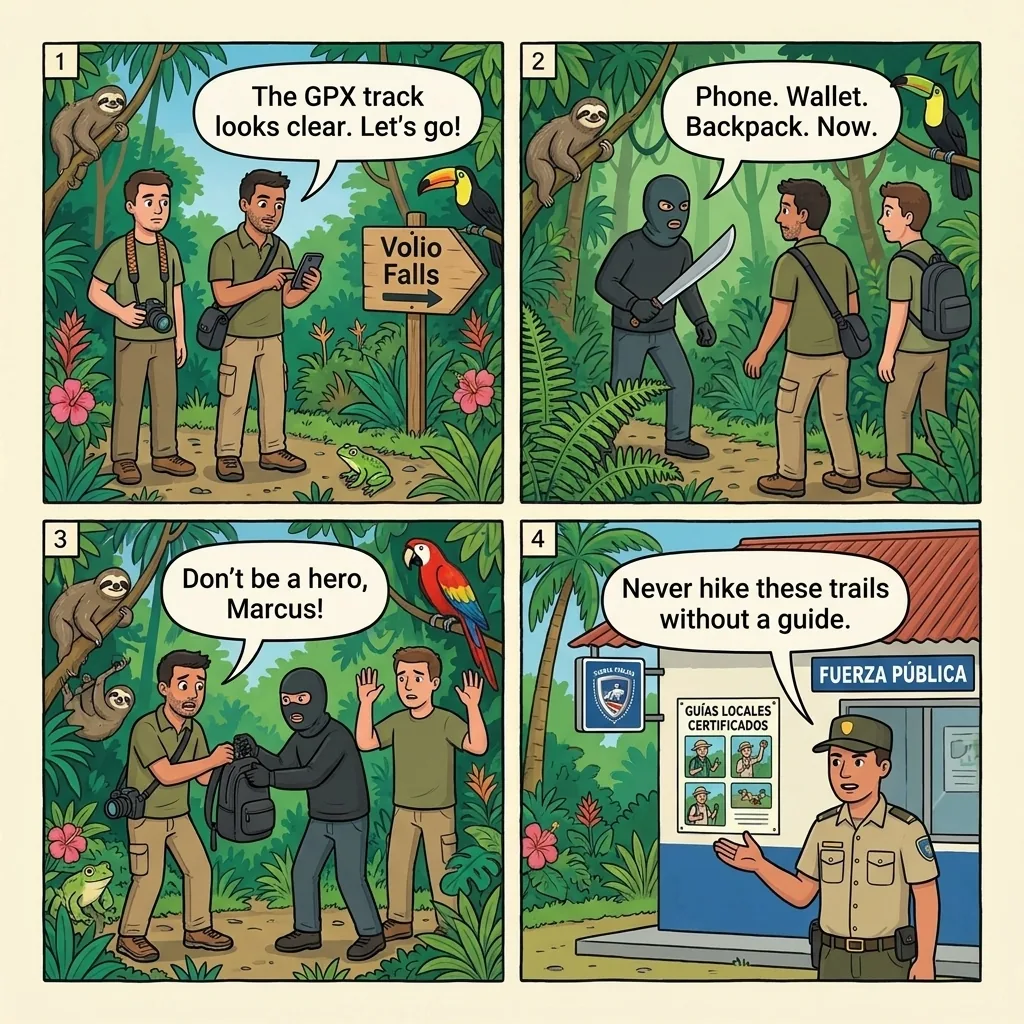
A masked man steps onto the Volio or Bribri waterfall trail with a machete at a jungle chokepoint and demands cash, phones, and cards from hikers — the pattern has been running since 2023 with fresh documented incidents through 2026.
You leave Puerto Viejo with a friend or a self-guided GPX file, drive ten minutes inland to the Volio trailhead, and step into thick rainforest with the rush of a waterfall in the distance. The dirt track narrows as the canopy closes overhead. Cell service drops two bars in the first kilometer and disappears entirely by the time the trail descends toward the falls. A few signs are nailed to trees, but there is no ranger booth, no SINAC gate, and no uniformed patrol — the Kekoldi and Bribri territories operate outside the national-park system, and the tourists hiking through them assume someone is watching. No one is.
A masked man steps out of the foliage with a machete at the chokepoint just before the waterfall pool. Sometimes he is alone, sometimes a second man closes off the trail behind you. The demand is fast and clear: cash, phones, cards, watches, the daypack itself. Hikers who reached for a phone to film have been chased; in 2025 a traveler attached a police report describing being chased through the jungle and robbed by a machete-wielder, and earlier Google reviews warned of the same masked attacker carrying both a machete and a firearm. The February 2026 murder of an American resident in Cahuita reset how locals talk about the corridor — the trail robberies are no longer treated as opportunistic. Fuerza Pública response from the Calle 217 station runs thirty minutes or more, by which time the attacker has melted back into the territory.
The trail is the trap, and the only reliable defense is not walking in alone. ICT-certified operators — Terraventuras, Exploradores Outdoors, and Caribe Shuttle — run guided hikes to the same waterfalls with a known driver, a satellite radio, and a route negotiated with the territory; the price is higher than a $20 stranger in town, and the difference is exactly what you are paying for. Inside Cahuita National Park (Kelly Creek and Puerto Vargas ranger booths) and on supervised Jaguar Rescue Center tours, the risk profile collapses to near zero. Never hike Volio, Bribri, or any inland Caribbean waterfall without an ICT-certified guide booked through a vetted operator, and if a man with a machete steps onto the trail, surrender everything immediately — the cash is replaceable.
Red Flags
- Any 'guide' approaching you on Puerto Viejo main street offering a $20–$30 cash Volio or Bribri waterfall hike
- Unmarked trailhead off Route 36 with no SINAC signage and no paid entrance booth
- 'Local' insists on leading you up a path where there is no cell signal and no other hikers
- Google reviews and recent Reddit posts flagging machete robbery on the exact same trail
- Masked figure waiting at a narrow chokepoint before the waterfall pool
How to Avoid
- Book ONLY with ICT-certified agencies: Caribe Shuttle (caribeshuttle.com), Terraventuras, Exploradores Outdoors, Jaguar Rescue Center.
- Stick to paid-entry protected areas: Cahuita National Park, Manzanillo refuge core trail, Punta Uva beach-only routes.
- Carry a decoy wallet with ₡10,000 in small bills; leave passport in the hotel safe.
- Never hike waterfalls in Bribri / Kekoldi territory alone, at dawn, or after 3 PM.
- If attacked, comply fully; dial 911 and Fuerza Pública Puerto Viejo (town station, Calle 217) or Tourist Police 2586-4052.
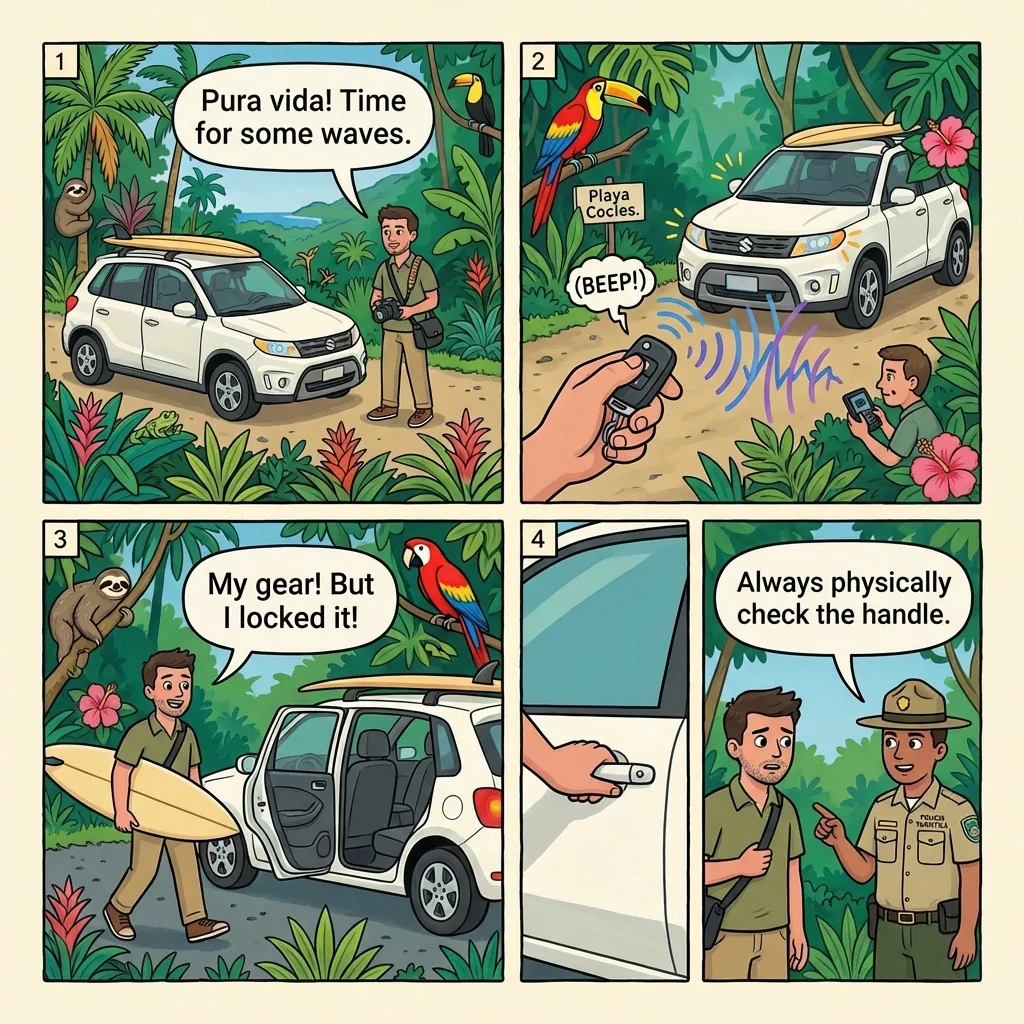
A thief with a handheld RF jammer sits within twenty meters of the Playa Cocles or Chiquita beach lot, blocks your fob signal as you press lock, and empties the rental while you surf — losses run from a backpack to $14,000 in camera gear, and the doors never actually locked.
You roll into the dirt pullout at Playa Cocles or one of the Route 256 beach accesses on the way to Manzanillo, board on the roof rack, two backpacks in the trunk. You step out, press the lock button on the fob, see the lights flash and the LED blink on the key, and walk down the path to the sand. The rental — a Suzuki Grand Vitara, a Hyundai Tucson, whatever Adobe or Vamos handed you at SJO — is the most common rental in the Caribbean province because it can clear the potholes between Cahuita and Manzanillo. It is also the most common target.
A man with a small black device sits in the brush twenty meters away. The device is a $40 RF jammer tuned to the 315 or 433 MHz band the fob broadcasts on; when you press lock, the jammer drowns the signal before the car receives it. The doors never engage. The fob blinks and the interior lights flash because those are local indicators on the key itself, not confirmation from the car — to the driver walking toward the beach, the lock cycle looks identical. Three minutes after you crest the dune the jammer operator opens the unlocked door, sweeps the contents into a duffel, and walks back into the jungle. A November 2025 PSA documented a surfer who lost his belongings this way at one beach and caught a second man attempting the same setup the next morning at another. A photographer in a parallel Costa Rica thread lost $14,000 in camera gear from a "locked" rental. Stolen electronics reappear in Limón city pawn shops within the week.
The defense is mechanical and takes two seconds. After you press the fob, walk to the door and physically pull the handle — if it opens, the jammer worked, and you should re-press the fob while standing closer to the car or use the manual key blade hidden inside the fob. Strip everything from the cabin every time you park: cameras, laptops, daypacks, even empty bags that suggest something is in the trunk. The legitimate supervised lots — Rocking J's, the community lot opposite Cafe Rico at Cocles, Maxi's at the Manzanillo end of Route 256 — cost about $3 plus a ₡1,000 tip and are worth it on every beach day. Always physically tug the door handle after pressing lock, and never leave anything in a rental car at a Caribbean-coast beach lot, ever.
Red Flags
- Fob lock button produces a light flash but the door handle actually still opens
- Man loitering 10–20 m from your car holding a phone or boxy device in the parking area
- Car parked in an unfenced dirt pullout at Playa Cocles, Chiquita, or Punta Uva with no attendant
- You left a backpack or camera bag visible — thieves scout for items before jamming
- Rental agency issued a flashy new keyless-entry SUV instead of an older manual-key model
How to Avoid
- Physically tug the door handle after pressing lock; if it opens, press lock again or use the key manually.
- Carry an RFID Faraday pouch for the key fob — ~$10 on Amazon, blocks both jam and relay attacks.
- Park only in supervised lots (Rocking J's, Cafe Rico-adjacent attendant lots on Playa Cocles) and tip ₡1,000.
- Never leave anything in the car — empty the trunk completely, leave glove box open to show it's empty.
- Photograph all contents before every departure so the insurance claim has evidence.
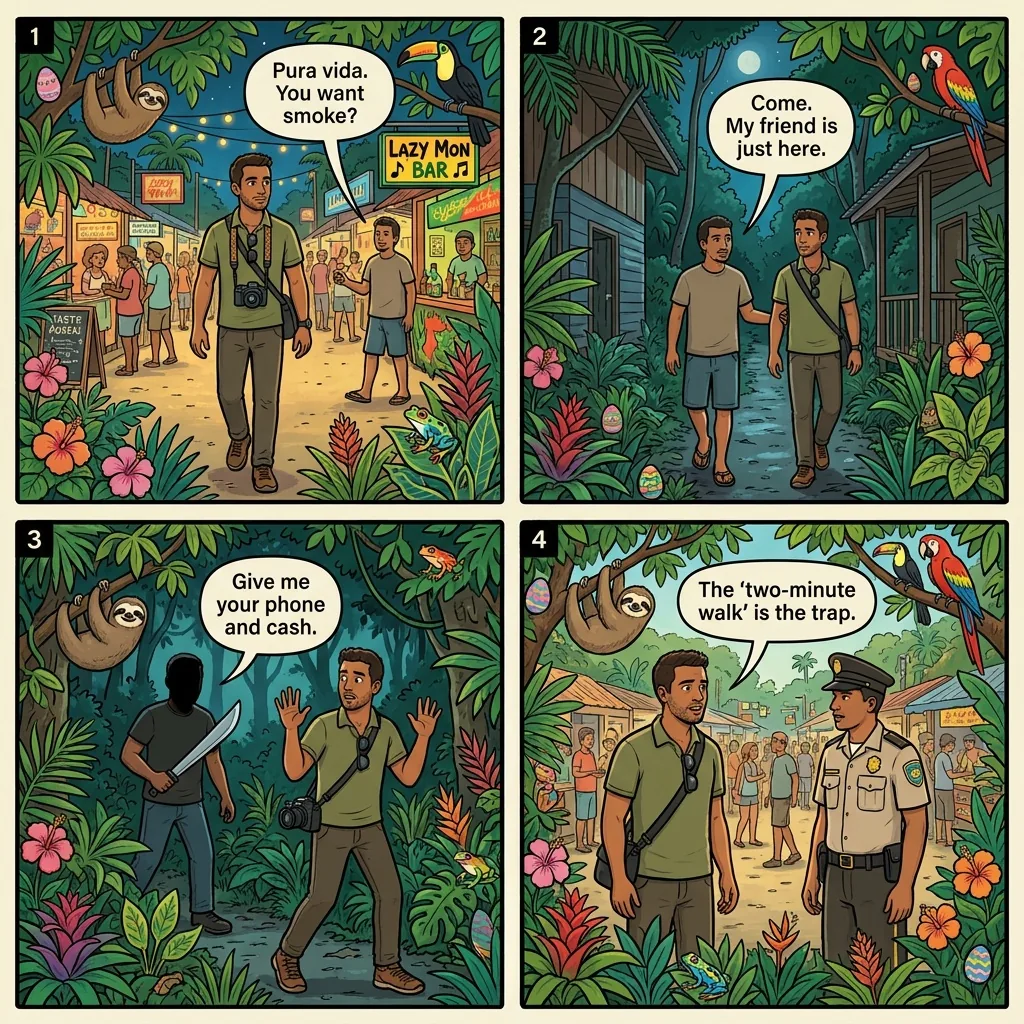
A street dealer on Calle 217 offers cannabis or cocaine, then walks you down a dark side-path to "complete the sale" where you are robbed at machete- or knifepoint, sold oregano in a baggie, or short-changed by a confederate who vanishes — the scam is not the product, it is the walk.
Calle 217 is the spine of Puerto Viejo nightlife. The street is a single block from Lazy Mon to Hot Rocks, lined with sodas and beach bars and reggae bass leaking from open doorways, and as a tourist on it after 9 PM you will be offered weed and cocaine repeatedly. The pitch is casual — a quick "you want smoke?" as someone walks past, sometimes a friendlier setup with a few minutes of small-talk about where you are from. The product is real often enough to keep the offer believable, and the dealer never handles the substance on the main street; the deal happens elsewhere. "Come, very close, two minutes."
The two-minute walk is the scam. The dealer leads you off Calle 217 and onto an unlit side-street or a footpath into the brush, and at the pickup the script forks. In the robbery version, a second or third man is waiting at the chokepoint with a machete or a knife, and the demand is for cash, phone, and the chain off your neck. In the bait-and-switch version, you are handed a baggie of oregano or baking soda and the dealer is gone before you open it. In the short-change version, a confederate distracts you mid-handover and the dealer pockets your bills and walks. A March 2025 thread from a young female traveler described being followed by three men from different directions and having to run for the rental car as they surrounded it; the dealer economy and the after-hours catcall economy on Calle 217 overlap, and once a tourist looks like a customer they look like prey.
The cleanest defense is to keep the transaction from starting. A firm "no gracias" without breaking stride works the vast majority of the time; do not negotiate price, do not ask "how much," do not walk fifteen meters with anyone offering anything. After dark, stay on the well-lit Calle 217 corridor where the bars and sodas have eyes on the street, and travel in pairs past 9 PM. If a group surrounds you, step into Soda Lidia, Koki Beach, Lazy Mon, or Bread & Chocolate and have staff call a tuk-tuk (₡2,000–₡3,000) or 911. Never follow anyone off Calle 217 to buy drugs in Puerto Viejo — the walk is the trap, regardless of which version of it the dealer is running tonight.
Red Flags
- Male stranger matches your walking pace and asks 'you want weed, cocaine, something?' then insists you walk with him
- Dealer points down a dark side-alley or jungle path 'just one minute' to make the sale
- Cluster of 3–4 men loitering outside Hot Rocks after 9 PM watching the doorway
- You've been catcalled twice on the same block — usually the same crew scouting
- Dealer asks to see your cash first or insists on payment before handing over product
How to Avoid
- Do not buy recreational drugs in Puerto Viejo — the mugging/fake-product risk is higher than the product value.
- Firm 'no gracias' and keep walking on Calle 217; never engage in small-talk with street salesmen.
- Walk in pairs after 9 PM; women travelers especially follow one traveler's warning.
- Use a tuk-tuk (₡2,000–₡3,000) or Uber from the bar strip back to lodging rather than walking jungle paths.
- Duck into Soda Lidia, Lazy Mon, or Bread & Chocolate and ask staff to call 911 if cornered.
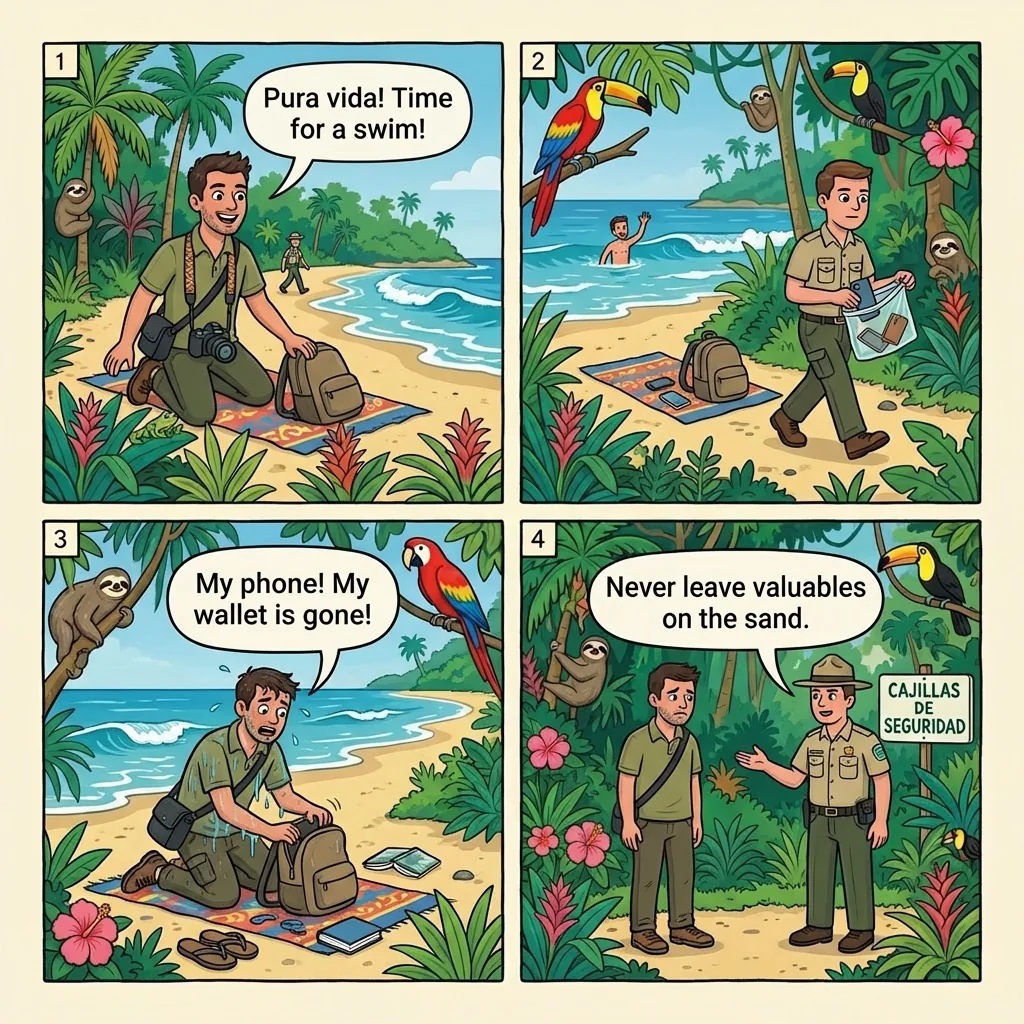
A scout walking the sand-line at Playa Cocles, Chiquita, or Punta Uva watches you swim past the break, scoops the phone and wallet off your towel into a plastic grocery sack, and disappears down a pre-mapped jungle footpath — losses are non-violent but virtually guaranteed if anything stays on the sand.
You stake out a patch of sand at Playa Cocles or Playa Chiquita on a clear afternoon, stretch the towel, drop the daypack with a phone and a wallet inside, and walk into the surf. Cocles is the hero shot of the South Caribbean coast — open ocean, jungle pressing right up to the dunes, almost no infrastructure on the beach itself. There is one seasonal lifeguard station and a long stretch of unsupervised sand on either side of it. Chiquita and Punta Uva have none. A scout in shorts and a tank-top has been walking that sand-line for an hour, watching swimmers commit to the water.
Once you are thirty meters past the break, the scout walks past your towel at a normal pace, scoops the bag and the phone and the wallet into a plastic grocery sack, and continues toward the tree line. The sandals, sunglasses, and towel stay where you left them so nothing looks disturbed from the water. By the time you swim back twenty minutes later, the scout is half a kilometer down a jungle footpath that connects to Route 256. Snorkelers at Punta Uva and Manzanillo lose line-of-sight with the beach for thirty minutes at a time on the reef, and that window is wide enough for the same scout to clear two or three towels in one sweep. Locals have a proverb that runs alongside "en el carro nunca" — "en la playa nunca." Drones and action-cams left mounted on tripods while the owner is in the water disappear in the same way.
The fix is to bring nothing the scout would want. Pack a mesh tote with reef-safe sunscreen, a towel, about ₡10,000 in small bills, and a decoy flip-phone with offline maps if you need navigation; passports, real phone, credit cards, and the camera stay in the accommodation safe. If you must carry a real phone for safety, run it on a lanyard around your neck inside a Nite Ize or Quiksilver waterproof dry-pouch and swim with it. At Cocles, park at the community Beach Guardado lot opposite Cafe Rico ($3 plus a tip); at Manzanillo, use the supervised Maxi's lot at the end of Route 256. If something does walk off, file the police report at the Fuerza Pública station on Calle 217 the same day — Allianz and World Nomads both require it for the claim. Bring nothing to a Caribbean-coast beach you are not willing to lose, and never leave a phone, wallet, or camera unattended on a Cocles, Chiquita, or Punta Uva towel while you swim.
Red Flags
- Man (often shirtless) walking the high-tide line with a plastic grocery sack pretending to beach-comb
- Beach section with zero lifeguard booth and no other tourists within 100 m — classic hunting ground
- You can no longer see your bag from the water — if yes, distance is too great
- Drone or action-cam left on a tripod with the operator in the surf
- Loose shoreline dogs being used as a distraction while a partner approaches the towel
How to Avoid
- Take a mesh tote with ONLY towel, sunscreen, ₡10,000 cash, and a decoy phone — real phone and passport in hotel safe.
- Swim in pairs, rotating one-in-one-out every 20 minutes; never both in the water at once.
- Park in supervised lots only: Cocles Beach Guardado ($3), Maxi's Manzanillo lot.
- Use a waterproof Quiksilver / Nite Ize dry pouch on a lanyard if you must bring a real phone in the water.
- Photograph serial numbers of any electronics in advance; file Fuerza Pública report for insurance claim.
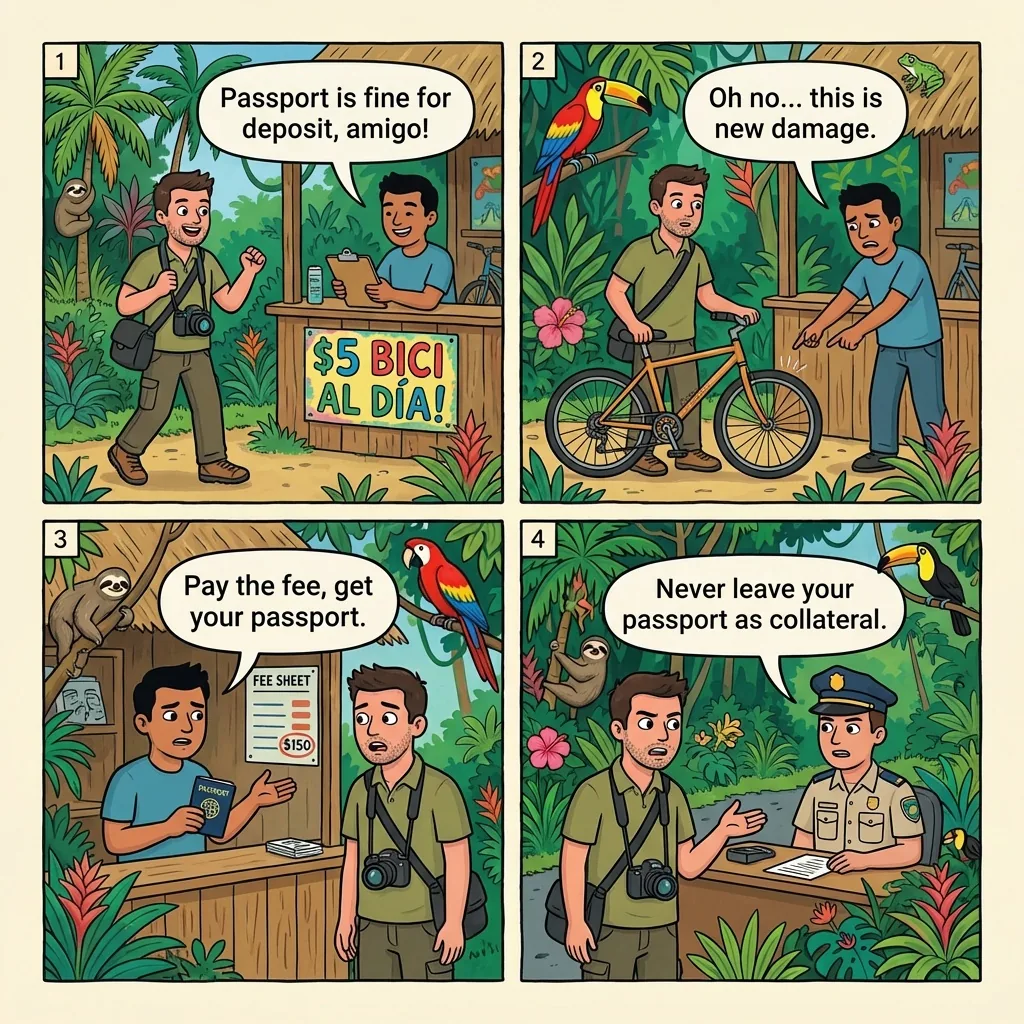
A Calle 217 bike shop advertises a $5/day rental, then demands your passport as deposit at pickup and invents a $60–$150 "scratch damage" fee on return — refuse to pay and the passport stays behind the counter until you do.
The 13-kilometer Route 256 from town through Cocles, Chiquita, and Punta Uva to Manzanillo is the iconic Caribbean-coast bike ride, and almost every visitor wants in. Calle 217 is dense with shops — some legitimate, some not — and the scam shops advertise the lowest day rate visible on the street: $5 a day for a beach cruiser, half what Tuanis Shop or Dogg Bikes charge nearby. The attendant is friendly, hands you a clipboard with a contract in Spanish, and asks for the deposit. The shop "doesn't take credit cards." The deposit is $200 cash, or your passport as collateral. You hand over the passport and ride out.
The trap closes on return. The attendant inspects the bike with a magnifying-glass intensity that did not exist at pickup, finds a "new" scratch on the chainstay or a rust spot near the seatpost, and pulls out a damage schedule that suddenly contains a $60–$150 fee — cash only, dispute it later. The passport stays behind the counter until the cash crosses. Replacement at the US Embassy in San José is a four-hour bus ride and a $130 fee, so most travelers pay. A second flavor swaps the damage fee for a stolen-bike charge: the shop provides a flimsy $3 cable lock, the bike is taken during a lunch stop in Punta Uva, and a contract clause makes you liable for $400–$600 per beach cruiser or $800–$1,200 per mountain bike. A third flavor uses pre-existing damage rushed past you at checkout. Across all three, the leverage is the deposit you handed over before the ride.
Pick the shop before the deal starts. Tuanis Shop on Calle 217 near Bikini Beach and Dogg Bikes are the two most-reviewed legitimate operators in town; both rent at the standard $10–$15 a day for a beach cruiser and $20–$25 for a mountain bike, accept credit-card holds, and provide a real U-lock with the rental. Costa Rican law does not require you to surrender a passport as deposit, so offer a credit-card hold or a photocopy plus a cash deposit instead. Photograph every side of the bike and the lock before you ride out, have the attendant initial existing scratches on the receipt, and U-lock the frame plus the rear wheel to a concrete post (not a banana tree, not a removable handrail) on every stop. At Manzanillo, leave the bike inside Maxi's fenced lot for a $1 tip rather than chained on the beach path. Never hand a Puerto Viejo bike shop your passport as deposit, and if a shop refuses to return it, call the Tourist Police on 2586-4052 — passport holding is extortion under Costa Rican law.
Red Flags
- Shop demands your passport as deposit and refuses a credit-card hold
- Advertised $5/day rate that reveals $20 'insurance' and $100 cash deposit at pickup
- Attendant rushes you through the paperwork and won't walk the bike with you marking scratches
- Only a thin cable lock provided — guaranteed cut in under 2 minutes with bolt cutters
- No printed English contract, only a handwritten receipt with no shop phone number
How to Avoid
- Rent only from shops with 4.5+ Google review scores — Tuanis Shop or Dogg Bikes on Calle 217.
- Never surrender your passport; offer credit card hold or photocopy + cash deposit instead.
- Photograph every side of the bike + lock with timestamps, have attendant initial pre-existing damage on receipt.
- Insist on a U-lock (not cable); lock through frame + rear wheel to an immovable concrete post.
- Park at Maxi's fenced lot in Manzanillo; re-photograph bike on return before attendant can invent damage.
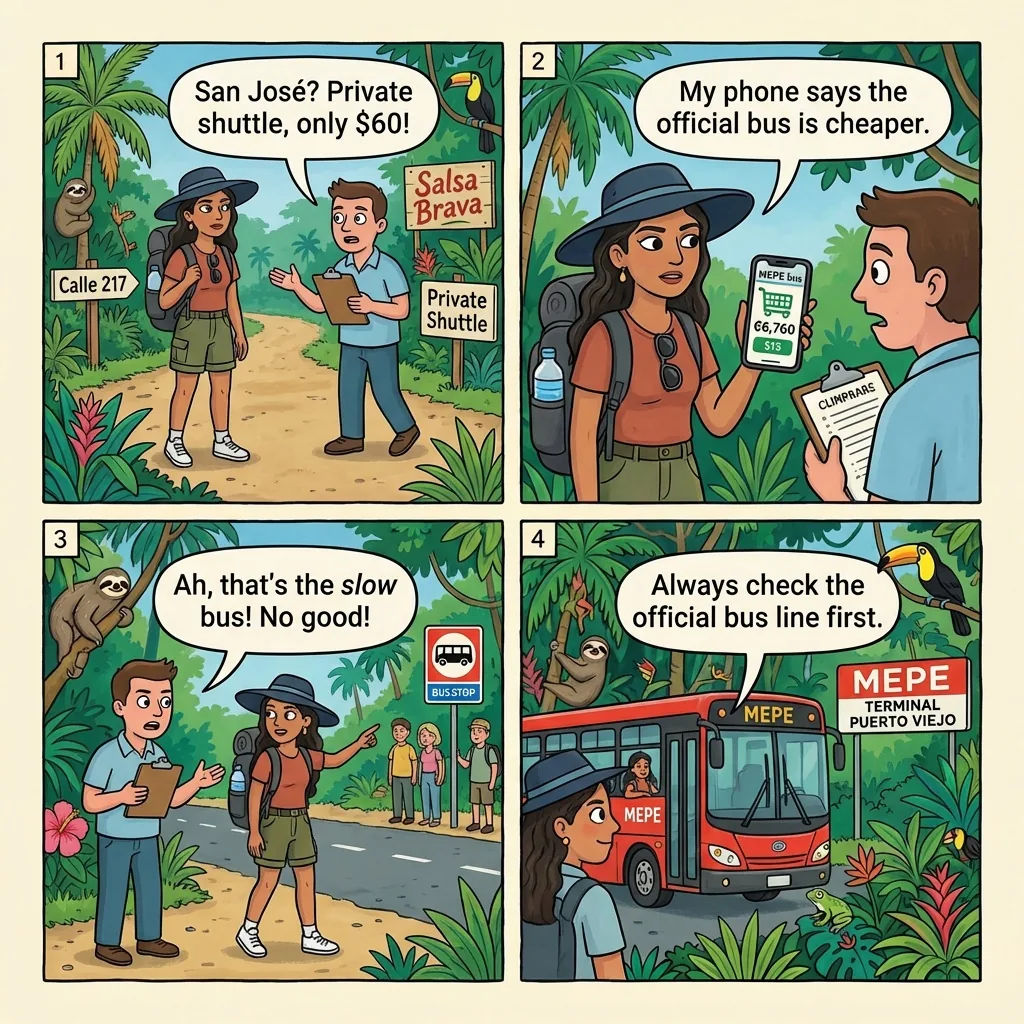
A Calle 217 hostel tout sells you a $50–$100 "private shuttle" to San José that either does not exist, stacks fourteen people into a ten-seat van, or routes through a hostel drop-off for a second $20 "terminal fee" — the legitimate MEPE bus on the same route is $12–$13.
The 4.5-hour run between San José and Puerto Viejo is the most-scammed tourist transport route on the Caribbean coast because the price gap is enormous. The legitimate Autotransportes MEPE bus departs five times a day from the Gran Terminal del Caribe in San José for ₡5,960–₡6,760 — about $12–$13 — with a senior fare around ₡4,960. The legitimate shared door-to-door shuttle services, Caribe Shuttle and Interbus, run $54–$79 per person with hotel pickup and an organized luggage system. Anything sold to you between those two price points by a stranger on the street is, almost without exception, a scam.
The unlicensed operators work Calle 217 the way ticket touts work a stadium. A guy outside a hostel asks where you are going next, hears "San José," and offers a "private shuttle, leaves at 8, $80 each, hotel pickup." Sometimes the van shows up and is a tourist-stuffed minivan with fourteen people crammed into ten seats; sometimes it never comes and the WhatsApp number stops responding. A common variant routes the shuttle through a random hostel "transfer point" where a second driver demands a $20 "terminal fee" before continuing — pay it or get off in Limón at midnight. Facebook ads and Instagram DMs run the same scam from offshore; February 2025 traveler threads document the playbook in detail, and a widely-shared reel summed it up as "local bus over $50 shuttle." The scam is not the price, it is the absence of any operator behind the booking when something goes wrong.
Two channels are safe and they cost what they cost. For the bus, walk into the Gran Terminal del Caribe ticket window at Calle Central and Avenida 11 in San José or email MEPE for a reservation; arrive fifteen minutes early with ₡10,000 cash for the fare and a ₡1,000 baggage handling tip. For the door-to-door, book caribeshuttle.com ($54 PV–SJO) or interbusonline.com directly, or have your hotel concierge make the booking — both options issue an email confirmation number you can verify the morning of travel. Avoid Viator and GetYourGuide resellers; they take a 30% markup on the same seat. The Caribe Shuttle office is at Calle 213 and Avenida 69 next to Flip Flop Store if you want to confirm in person. Never buy a San José shuttle ticket from a Calle 217 hustler — book MEPE directly at the bus terminal or Caribe Shuttle and Interbus directly online, and confirm an email reservation number the day of travel.
Red Flags
- Hostel lobby or Calle 217 tout selling a 'shuttle' for $30–$50 without a printed company name / QR receipt
- Operator demands full cash payment upfront with no booking number
- Shuttle ticket printed on plain paper without caribestrail.com / interbusonline.com logo
- Driver stuffs 14 people into a 10-seat van, or drops you at a 'transfer point' asking for a second fee
- Advertised fare far below market ($20 SJO–PV one-way) — MEPE is $12, real shuttles start $54
How to Avoid
- MEPE: buy directly at Gran Terminal del Caribe (Calle Central, Av 11) window, ₡5,960–₡6,760 cash.
- Shuttle: book only at caribeshuttle.com ($54) or interbusonline.com; hotel concierge acceptable.
- Arrive 15 minutes early at MEPE window; carry ₡1,000 per checked bag.
- Avoid Viator / GetYourGuide resellers — 30% markup; use the operator's own website.
- Confirm every shuttle has an email confirmation + QR; no confirmation = phantom booking.
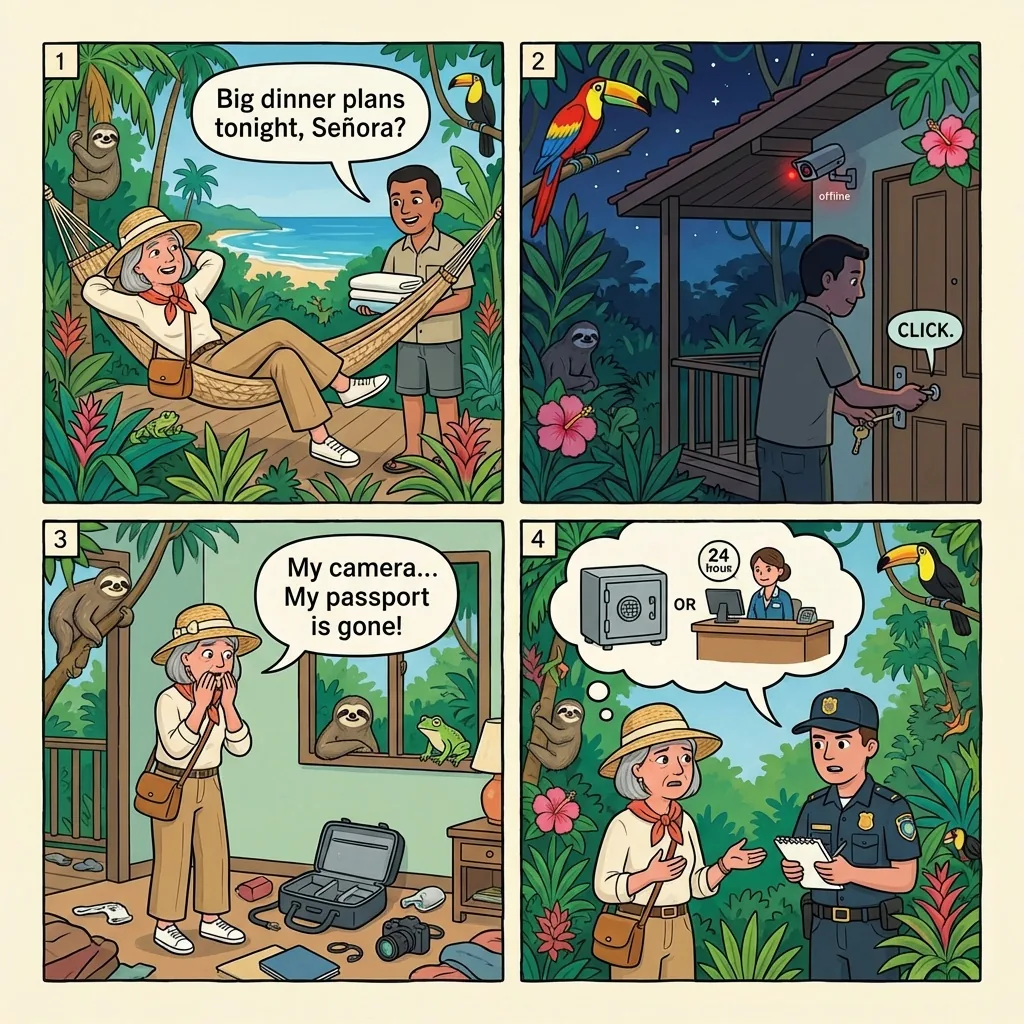
A Playa Cocles or Punta Uva villa caretaker who holds the only key tips off an accomplice the night you announce a dinner out, then stages a "power outage" that disables battery cameras while the unit is ransacked — average loss runs $2,000–$8,000 in laptops, cameras, cash, and passports.
You book a beachfront villa or cabina off Route 256 in Playa Cocles or Punta Uva — somewhere away from the Calle 217 noise, with a private pool, a hammock under palm trees, and a single caretaker who handles check-in, cleaning, and questions. The caretaker is friendly, knows the area, and asks helpful questions on day one: where are you eating tonight, how long are you staying, are you doing the Manzanillo trip, what time would you like fresh towels. You answer because the questions are reasonable and the caretaker has the only spare key. The villa has no on-site front desk, no shared common area, and no neighbors within shouting distance.
On the night of a longer trip — a sunset dinner in Manzanillo, a late reggae set at Lazy Mon — the power goes out at the villa for the first time during your stay. The Wyze or Ring cameras die because the property does not have a cellular battery backup. The door is unlocked when you return because the caretaker arranged it that way; sometimes the caretaker commits the burglary directly, sometimes they tip off an accomplice with the timing, the layout, and the drawer where the cash is kept. There is no forced entry. The laptop, the camera, the second phone, the cash from the kitchen drawer, and any passports you did not lock down are gone. The caretaker is "heartbroken" the next morning. Reddit threads on Caribbean-side rentals document the pattern repeatedly, and the February 2026 home-invasion murder of an American resident in Cahuita raised the profile of acquaintance-driven property crime in the corridor.
The defense is to remove the caretaker from the equation. Boutique properties with twenty-four-hour staffed front desks — La Costa de Papito on Playa Cocles, Azania Bungalows and Shawandha Lodge on Playa Chiquita, Selvin's Cabinas at Punta Uva, Cariblue Beach & Jungle Resort — eliminate the single-key risk because there is always someone awake on the property. If you do book a caretaker-only villa, lock a Pacsafe Travelsafe 12L to the bed frame for passports, cash, and electronics; install a Wyze or Ring mini-camera with cellular cloud backup at the entry; and read every Airbnb or VRBO review for the canary phrases "power was out," "felt watched," or "asked when we'd be home." Never share your daily plans — keep it to a vague "we'll be out for a few hours." Buy travel insurance with theft coverage from Allianz Global, World Nomads, or a Chase Sapphire Reserve rider, and photograph serial numbers of every electronic before you leave home. Book a Caribbean-coast property with twenty-four-hour on-site staff rather than a caretaker-only villa, and never tell the caretaker when you will be out for the evening.
Red Flags
- Airbnb / VRBO listing has a caretaker but no on-site staff; the caretaker controls the only key
- Property has 'frequent power outages' mentioned in multiple reviews
- Caretaker asks detailed questions about your daily itinerary or pick-up times
- No working security camera despite being advertised as having one
- Remote jungle cabina off Route 256 with no neighbors within shouting distance
How to Avoid
- Book boutique hotels with 24/7 front desk: La Costa de Papito, Azania, Shawandha, Selvin's, Cariblue.
- Use a Pacsafe Travelsafe 12L ($60) locked to bed frame for passports, cash, electronics.
- Never share your daily plans with the caretaker — vague answers only.
- Install a Wyze or Ring mini-camera with cellular cloud backup facing the entry door.
- Carry theft-covered travel insurance (Allianz Global, World Nomads) + document all serials in advance.
🆘 What to Do If You Get Scammed
📋 File a Police Report
Go to the nearest Fuerza Pública / OIJ (Organismo de Investigación Judicial) station. Call 911 (general) or 800-8000-645 (OIJ tip line). Get an official crime report — you'll need this for insurance claims. You can also report online at poder-judicial.go.cr.
💳 Cancel Your Cards
Call your bank immediately. Most have 24/7 numbers on the back of the card (keep a photo saved separately). Block any suspicious transactions before the thieves use your details.
🛂 Lost Passport?
Contact the US Embassy in San José at Calle 98 Vía 104, Pavas, San José. For emergencies: +506 2519-2000 (after hours +506 2220-3127). Policía Turística (Tourist Police) hotline: 2258-1008 / 2258-1022. ICT tourist info: 2286-1473 / 1-800-TOURISM.
📱 Track Your Device
If your phone was stolen, use Find My (iPhone) or Find My Device (Android) from another device. Don't confront thieves yourself — share the location with police instead.
Frequently Asked Questions
You just read 7 scams in Puerto Viejo. The book has 62 more across 11 Costa Rican destinations.
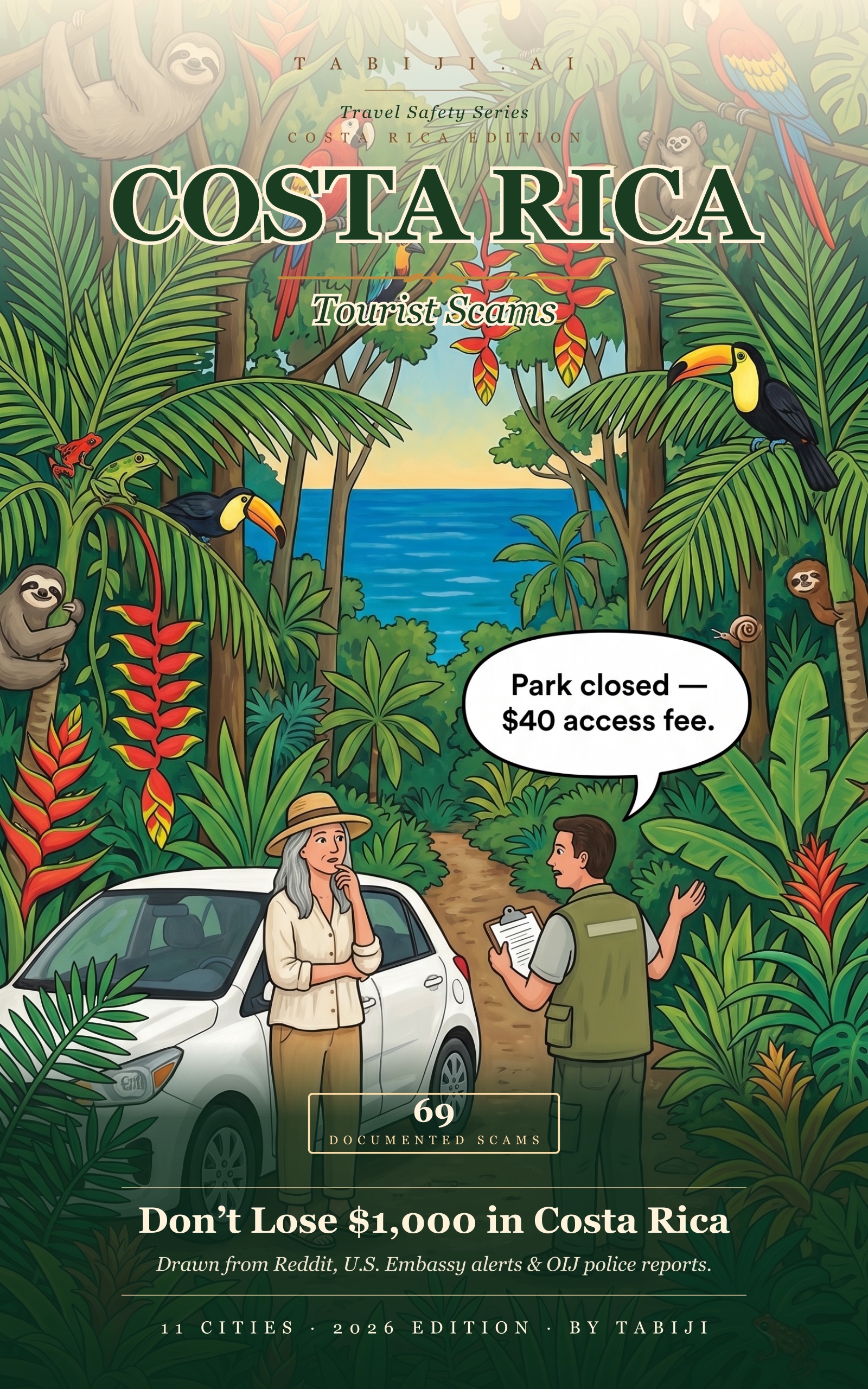
Manuel Antonio “park closed” fake-ranger $40 access-fee shakedowns. SJO airport taxi-meter overcharges. La Fortuna ATV / hot-springs bait-and-switch combos. Tamarindo 90-minute timeshare traps. Tortuguero turtle-tour “guide” demands. Every documented Costa Rica scam — with the exact scripts, red flags, and Costa Rican Spanish phrases that shut each one down. Drawn from Reddit, U.S. Embassy alerts, and OIJ (Organismo de Investigación Judicial) police reports.
- 69 documented scams across San José, Manuel Antonio, La Fortuna, Tamarindo & 7 more destinations
- A Costa Rican Spanish exit-phrase card you can screenshot to your phone
- Updated annually — buy once, re-download future editions free
- Readable in one flight — $4.99 on Amazon Kindle