
Key Takeaways
- The #1 reported scam is the 'Peregrino' Long-Con Fellow-Pilgrim Scam.
- 1 of 6 scams are rated high risk.
- Use app-based ride services (Uber, Bolt) or official metered taxis instead of unmarked vehicles.
- Never accept unsolicited offers from strangers near tourist sites in Santiago de Compostela.
⚡ Quick Safety Tips
- Never loan money to a fellow pilgrim regardless of how many days you've walked together — the 'peregrino' long-con is documented on traveler reports.
- The last 100 km of the Camino Francés must be walked continuously for the Compostela certificate — taxis and buses invalidate your credential.
- For luggage transfer, use JacoTrans (jacotrans.com) or Correos Paq Mochila (elcaminoconcorreos.com) at €5–€8 per bag per day with online booking.
- The Pilgrim Mass at Santiago Cathedral is free and open to all — ignore anyone selling 'reserved seats' or 'Botafumeiro access' outside.
- The Compostela certificate is free from the Oficina del Peregrino (Rúa Carretas, 33, +34 881 252 139) — no other fees apply for authentication.
Jump to a Scam
- High 'Peregrino' Long-Con Fellow-Pilgrim Scam
- Medium Camino 'Shortcut' Bus & Taxi Meter-Skipping
- Medium Santiago Airport (SCQ) & Old Town Taxi Overcharge
- Medium Cathedral Pilgrim Mass 'Reserved Seat' & Ticket Scam
- Medium Old Town Restaurant Tourist Menu near Cathedral
- Low Luggage Transfer 'Upgrade' & Private Pickup Scams
The 6 Scams

A long-game 'fellow pilgrim' scam runs the last 100 km of the Camino Francés (Sarria to Santiago, the minimum distance for the official Compostela certificate) — a friendly English-speaker walks at your pace for 3–7 days, shares meals and albergues, then asks to borrow €150–€400 'urgent, bank card stopped working' and disappears at the next town; never loan money to a fellow pilgrim regardless of how long you've walked together.
The last 100 kilometres of the Camino Francés from Sarria to Santiago is the minimum distance required for the official Compostela completion certificate, and it's the section that draws the largest mix of pilgrims — first-time walkers doing only the qualifying stretch, multi-week veterans, and the small population of long-game scammers who work the trust dynamics that build naturally over a week of shared meals and bunks. The scammer's profile is consistent: speaks good English, friendly, seems devout, walks at your pace, joins you for three to four days of meals and conversation, then needs to borrow €150–€400 with a banking-emergency story and disappears at the next town. Documented community accounts include a victim who was scammed out of €150 alongside another pilgrim scammed out of €400 by the same person playing the long game across a week of co-walking.
The Camino's culture of trust is what makes this work disproportionately well. Pilgrims share meals, share albergue bunks, and have long daily conversations on a journey explicitly framed as a spiritual or reflective walk — a week of walking together genuinely builds friendships, and the scammer exploits that intimacy with a story calibrated to feel embarrassing-but-resolvable rather than implausible. The 'urgent bank card stopped working, I'll pay you back tomorrow when the Santiago branch opens' framing has internal consistency for someone who's been camping in albergues for a week — banks are a genuine logistical issue on the Camino — and the small enough loan size (€150 rather than €1,500) reads as a fellow-pilgrim favour rather than a confidence trick. The disappearance at the next town is the standard exit, since the Camino's daily-stage rhythm makes 'I'll meet you in the next albergue' a normal phrase that takes 24 hours to register as a lie. Long-time pilgrim community guidance is consistent that the Camino has become tourist-trap-adjacent over the last decade and that this specific scam targets first-time walkers who haven't yet learned the 'never loan' rule.
For older pilgrims walking the last 100 km, the defense is to share meals and conversation freely while keeping cards, bank details, and loans entirely off the table. Never loan money to a fellow pilgrim regardless of how long you've walked together — a genuine pilgrim with a banking emergency should contact their embassy or home bank directly, not borrow from a co-walker — and if you feel social pressure to help, offer the name of the pilgrim's embassy and the Oficina del Peregrino phone number (+34 881 252 139) rather than cash, refusing every 'I'll pay you back tomorrow when the Santiago branch opens' framing as the standard exit script. The Compostela Cathedral's Oficina del Peregrino at Rúa Carretas 33 provides emergency assistance for genuine pilgrim distress and is the legitimate pathway. Share meals and conversation freely on the Camino — that's the point — but never share credit cards, bank details, or loans. If you've been scammed, file at the Policía Nacional station at Rúa Doutor Teixeiro 23 within 24 hours for insurance documentation; recovery is rare but the report number is what makes the home-country fraud claim work.
Red Flags
- Fellow pilgrim walking your pace develops friendship over 3–5 days before requesting a loan
- Loan request involves 'urgent' bank card failure, sick family member, or lost luggage
- Pilgrim avoids taking the call to their embassy or the Oficina del Peregrino
- Story details shift between tellings — dates, relatives' names, bank names
- Pilgrim vanishes after the loan — will not be at the agreed-upon meeting location next day
How to Avoid
- Never loan money to a fellow pilgrim, regardless of shared days on the Camino.
- Direct any genuine pilgrim emergency to their embassy or the Oficina del Peregrino (+34 881 252 139).
- Share meals and conversation freely; do not share credit cards, bank details, or loans.
- If pressured, offer contact information for embassy/police, not cash.
- File at Policía Nacional Rúa Doutor Teixeiro 23 within 24 hours if scammed.
At Sarria and the Camino del Norte splits, locals approach pilgrims with 'bus to next albergue €20' or 'taxi to beat the afternoon heat €30' shortcut offers — the routes lead to commission-paying businesses, the credential-stamping variant offers fake sellos for skipped stretches that the Oficina del Peregrino can detect and reject, and using transport on the last 100 km invalidates the Compostela.
The last 100 kilometres of the Camino Francés (Sarria to Santiago) and the Camino del Norte split junctions are the highest-density 'shortcut' tout zones, where locals approach pilgrims with 'bus to next albergue €20' or 'taxi to beat the afternoon heat €30' offers. The distances are often genuinely short (5–10 kilometres) and the 'shortcut' is sometimes routed along the actual marked Camino itself, but the destinations always lead to a commission-paying business — a particular café, an albergue with kickback arrangements, or a souvenir shop on the route. The framing is calibrated for tired pilgrims at the end of a long stage, when 'just this last bit by car' feels like a reasonable break rather than a credential-invalidating decision.
A parallel scam runs the credential-stamping play. Drivers offer to take pilgrims 'the last 10 kilometres in secret' and provide a legitimate-looking sello (the daily Camino stamp) at the destination as if the pilgrim walked it. This directly violates Camino rules — the last 100 km must be walked continuously or 200 km cycled for the Compostela certificate — and the Oficina del Peregrino in Santiago is trained to detect suspicious stamp patterns (impossible kilometre counts, stamps from places not on the route, identical stamping styles across days that should have varied). Pilgrims caught with shortcut sellos can have their Compostela denied at the office. Some albergue owners run a 'friendly transfer' variant offering €20 luggage rides that arrive at €30 'because of petrol' or end with the bag delivered to a different albergue. The Camino-veteran framework is consistent: informal services along the route are nearly always markups on what official channels provide for less.
For older pilgrims walking the last 100 km, the defense is to keep transport off the table for the qualifying stretch and to use only the two approved luggage-transfer services. Walk the last 100 km from Sarria to Santiago continuously for the Compostela certificate — taxis, buses, and 'shortcuts' invalidate the credential — and refuse every 'bus to next albergue €20,' every 'taxi to beat the heat €30,' every credential-stamping driver offering a fake sello, and every 'friendly transfer €20' from an albergue owner; for legitimate luggage transfer, use only JacoTrans (jacotrans.com) or Correos Paq Mochila (elcaminoconcorreos.com) at the published €5–€8 per day rate, both with online booking and pickup from any albergue by 8 AM. If you have a legitimate medical reason to skip a stretch (injury, illness), the Oficina del Peregrino at Rúa Carretas 33 in Santiago can review your case for accommodation — but 'I was hot' is not grounds for an exemption. The marked yellow arrow path is the Camino, and any 'shortcut' offered by a stranger at a junction leads to a commission business rather than the destination. Save the Oficina del Peregrino at +34 881 252 139 for any credential dispute.
Red Flags
- Stranger at a Camino junction offers 'shortcut' bus or taxi for €20–€50
- Taxi driver offers to provide a sello (stamp) at the end of the ride
- 'Shortcut' goes along the actual marked Camino rather than an alternative route
- Offer includes unrelated commission stops (souvenir shop, Galician craft workshop)
- Taxi driver vague about actual distance or refuses to show the planned route
How to Avoid
- The last 100 km from Sarria must be walked continuously — taxis/buses invalidate the Compostela.
- For luggage transfer, use JacoTrans or Correos Paq Mochila (€5–€8/day, transparent pricing).
- Follow yellow-arrow path markers; refuse 'shortcut' offers from strangers at junctions.
- For genuine injury, contact Oficina del Peregrino (+34 881 252 139) — they review exemptions.
- Get sellos (stamps) only at albergues, churches, or approved cafés along the official path.
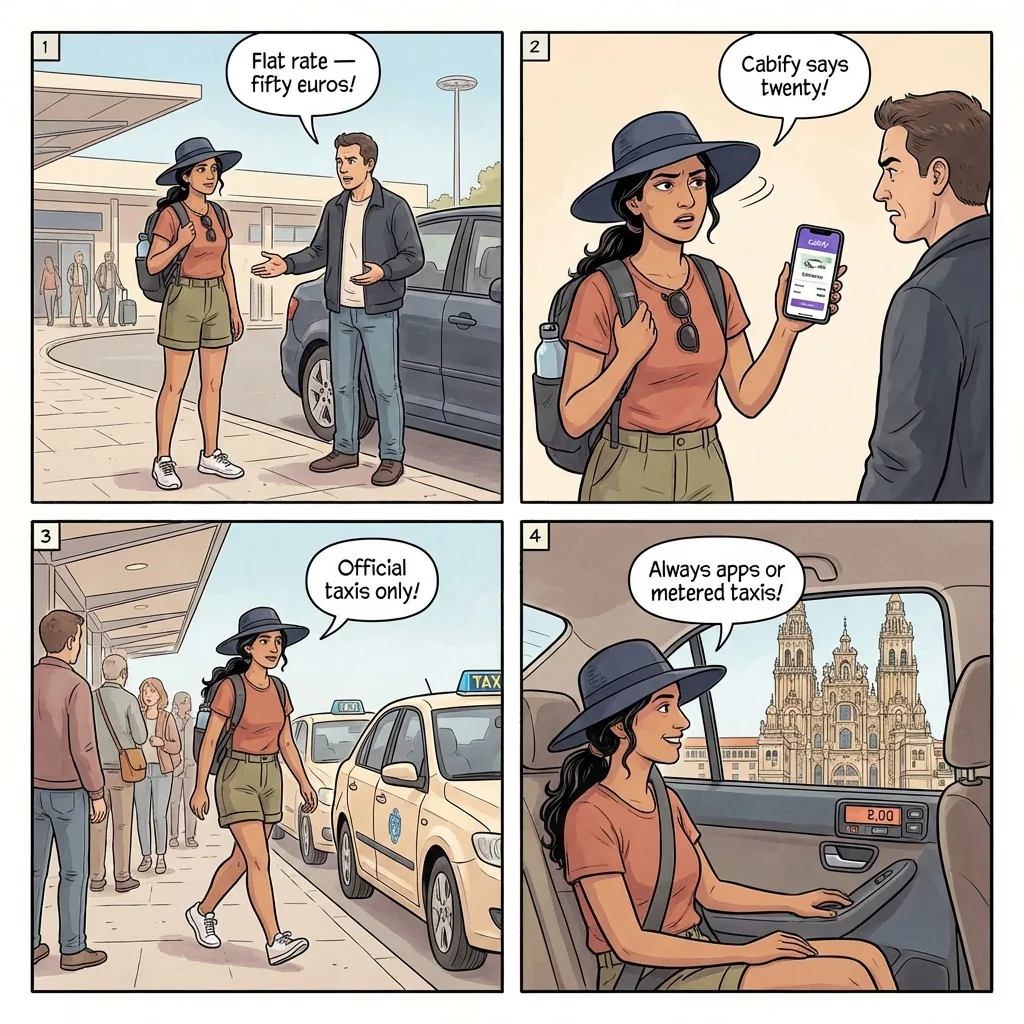
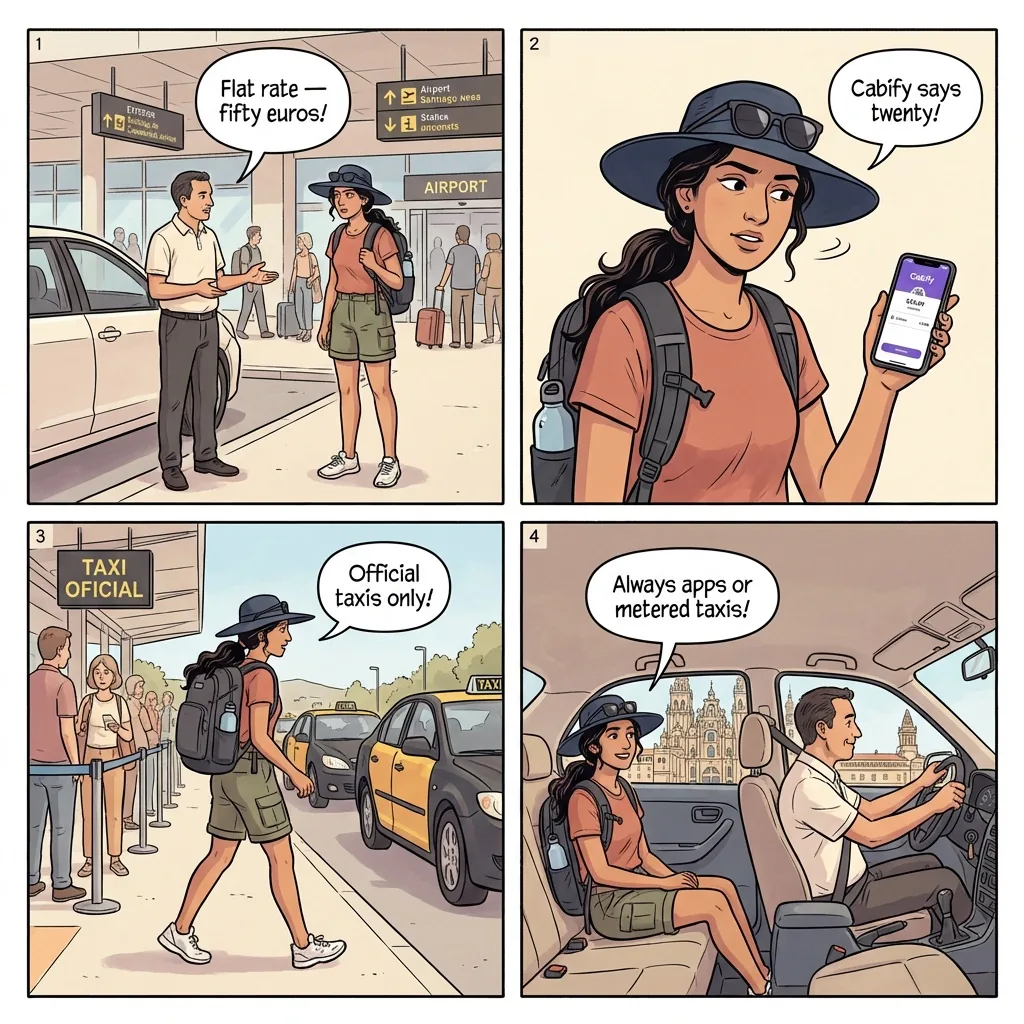
Santiago de Compostela Airport (SCQ, Lavacolla, 11 km out) has a regulated metered taxi fare to the city centre of €20–€25 (€1.06/km tariff 1 plus €3 airport supplement) — but unlicensed drivers quote €35–€50 flat, claim the meter is broken, or pad routes via the ring road, with the Galician tourist board issuing peak-Camino-season warnings; the Empresa Freire bus runs the same route at €3.
Santiago de Compostela Airport (SCQ, Lavacolla) is 11 kilometres east of the city centre and the main arrival point for international Camino pilgrims and Galicia visitors. The Spanish taxi-fare structure is regulated — tariff 1 at €1.06 per kilometre plus a €3 airport supplement makes a metered SCQ-to-centre run €20–€25 honestly — and the Empresa Freire Lavacolla-Santiago public bus runs the same route in 25 minutes for €3 every 30 minutes, making it the scam-free default for cost-conscious travelers. The trap economy operates around the airport taxi queue and the Estación Intermodal (combined bus and train station), with the Galician tourist board issuing specific warnings about SCQ taxi overcharging during peak Camino season (May–September) and Holy Year Xacobeo years.
The trap menu has three mechanics. Airport-curb drivers quote €35–€50 flat to the centre against the regulated €20–€25 metered, claiming 'the meter is broken' or 'fixed price airport rate' that doesn't legally exist. Long-route padding takes the ring road instead of the direct route, pushing a metered fare from €20 to €35–€40 by adding kilometres. At the Estación Intermodal, taxi-rank drivers quote inflated rates to pilgrims continuing to Fisterra or Muxía or planning A Coruña day-trips, banking on the assumption that arriving pilgrims don't know the local market — when the Old Town is pedestrianised and the walk from cathedral to station is 10 minutes on flat cobbled streets faster than waiting for a taxi. The hotel-transfer variant inside the city centre quotes €15–€25 for what's a €5–€10 metered fare. FreeNow and Cabify apps both operate in Santiago with regulated fares and are the strongest defense for travelers who want a fixed app-regulated price.
For older travelers arriving at SCQ or moving around the city centre, the defense is the Lavacolla bus or the metered taxi, never the curb-quoted flat rate. From SCQ, take the Empresa Freire Lavacolla-Santiago bus to the city centre at €3 in 25 minutes (every 30 minutes, scam-free) — or take a licensed taxi insisting on the meter at the regulated €1.06/km tariff 1 plus €3 airport supplement (€20–€25 honest fare to the centre) — and refuse every airport-curb 'fixed price €35–€50' quote, every 'meter broken' demand, every long-route padding via the ring road, and every Estación Intermodal 'cathedral €15' offer when the cathedral is a 10-minute walk on flat cobblestones. FreeNow and Cabify apps offer regulated fares for travelers who want a fixed app price. From the Estación Intermodal to the Old Town, walk rather than take a taxi — the 10-minute route through pleasant streets is faster than queuing. For pilgrims continuing to Fisterra or Muxía, Monbus runs daily coaches from Santiago bus station at €11–€15. Hotel-transfer fares inside the city centre should be €5–€10 metered — refuse any quote above €8 for this short route.
Red Flags
- Santiago Airport (SCQ) driver claims the meter is broken and quotes €35+ flat
- Route goes via the ring road rather than direct — adds 10 minutes and €10
- Taxi from Estación Intermodal to Old Town quoted above €10 (10-min walk)
- Driver adds 'Camino pilgrim fee' or 'luggage fee' beyond the meter
- Cash-only demand with no printed receipt
How to Avoid
- From SCQ airport, take the Lavacolla–Santiago Empresa Freire bus (€3, 25 min, every 30 min).
- If taking a taxi, insist on the meter; legitimate fare to city center is €20–€25.
- Use FreeNow or Cabify apps for regulated fares within Santiago.
- Walk from Estación Intermodal to Old Town — 10 min flat cobbled streets.
- For Fisterra/Muxía continuation, Monbus coaches from Santiago bus station €11–€15.

Plaza del Obradoiro touts outside Santiago Cathedral sell 'reserved seats' to the free Pilgrim Mass at €15–€30, 'guaranteed Botafumeiro access' at €50, and 'VIP viewing positions' at €80 — none exist (the cathedral doesn't sell or reserve Mass seats, and Botafumeiro swing dates are published free at catedraldesantiago.es) — and 'Compostela certificate authentication services' at €20–€50 sell paperwork for what's free at the Oficina del Peregrino.
Santiago de Compostela Cathedral runs the daily Pilgrim Mass at noon as the spiritual culmination of the Camino — entry is free, open to all, and the Botafumeiro (the giant silver censer that swings from the cathedral's nave) operates on a published calendar at catedraldesantiago.es with specific dates rather than every Mass. The cathedral seats approximately 1,000 attendees in the main nave, and arriving 30–45 minutes early is the only requirement for seated attendance. That entirely-free experience is exactly what makes the Plaza del Obradoiro tout economy possible — if there's a queue and a culturally-significant ritual, someone will sell fake access.
The trap menu has four recurring patterns. 'Reserved seat' tickets at €15–€30 per person — the cathedral does not sell or reserve seats for the Pilgrim Mass, and any 'reservation' is fictional. 'Guaranteed Botafumeiro access' at €50 — the Botafumeiro swings on the published calendar at catedraldesantiago.es, regardless of who's in the cathedral, and there's no way to 'guarantee' a swing on a non-scheduled day. 'VIP viewing position' at €80 — the cathedral has no VIP zones for the Pilgrim Mass; everyone is in the same nave. 'Compostela certificate authentication services' at €20–€50 — the Compostela is issued free by the Oficina del Peregrino at Rúa Carretas 33 to any pilgrim with a stamped credential who completed the qualifying distance, and the longer Certificate of Distance (showing kilometres walked) costs €3 from the same office. Anyone offering to 'authenticate' or 'certify' a Compostela for a fee is running a scam against a free official document. Some legitimate licensed Spanish tour guides do offer narrated cathedral tours at €15–€25 per person — these are verified through Guías Oficiales de Turismo de Galicia with a visible Xunta de Galicia credential and are a separate, real product.
For older travelers attending the Pilgrim Mass or collecting their Compostela, the defense is to know that nothing about either costs more than the €3 Certificate of Distance. The Pilgrim Mass is free and open to all — arrive 30–45 minutes early for seated attendance in the 1,000-seat nave — and check the published Botafumeiro swing calendar at catedraldesantiago.es before your visit so you can time the schedule yourself; collect the free Compostela certificate at the Oficina del Peregrino at Rúa Carretas 33 with your stamped credencial del peregrino, paying €3 only for the optional Certificate of Distance, and refuse every Plaza del Obradoiro tout selling 'reserved seats €15–€30,' 'guaranteed Botafumeiro €50,' 'VIP viewing €80,' or 'Compostela authentication services €20–€50' as outright fraud. Licensed Spanish tour guides can provide legitimate narrated cathedral tours at €15–€25 per person — verify the Xunta de Galicia credential and the Guías Oficiales de Turismo de Galicia listing before booking, and refuse any 'guide' on Plaza del Obradoiro without that visible accreditation.
Red Flags
- Tout outside Santiago Cathedral offers 'reserved seat' for Pilgrim Mass at €15–€30
- 'Guaranteed Botafumeiro access' quoted at €50+ (mass is free; Botafumeiro on published schedule)
- 'Compostela authentication' services offered at €20–€50 (certificate is free from Oficina del Peregrino)
- 'VIP seating' or 'front row pilgrim experience' packages
- Cash-only pressure outside the cathedral ticket office
How to Avoid
- The Pilgrim Mass is free — arrive 30–45 minutes early at 12:00 or 19:30 for seated attendance.
- Check catedraldesantiago.es for the published Botafumeiro swing schedule.
- The Compostela certificate is free from Oficina del Peregrino (Rúa Carretas, 33) with valid credential.
- The Certificate of Distance is €3 from the same office — no other fees apply.
- For guided cathedral tours, use Guías Oficiales de Turismo de Galicia (€15–€25 per person).
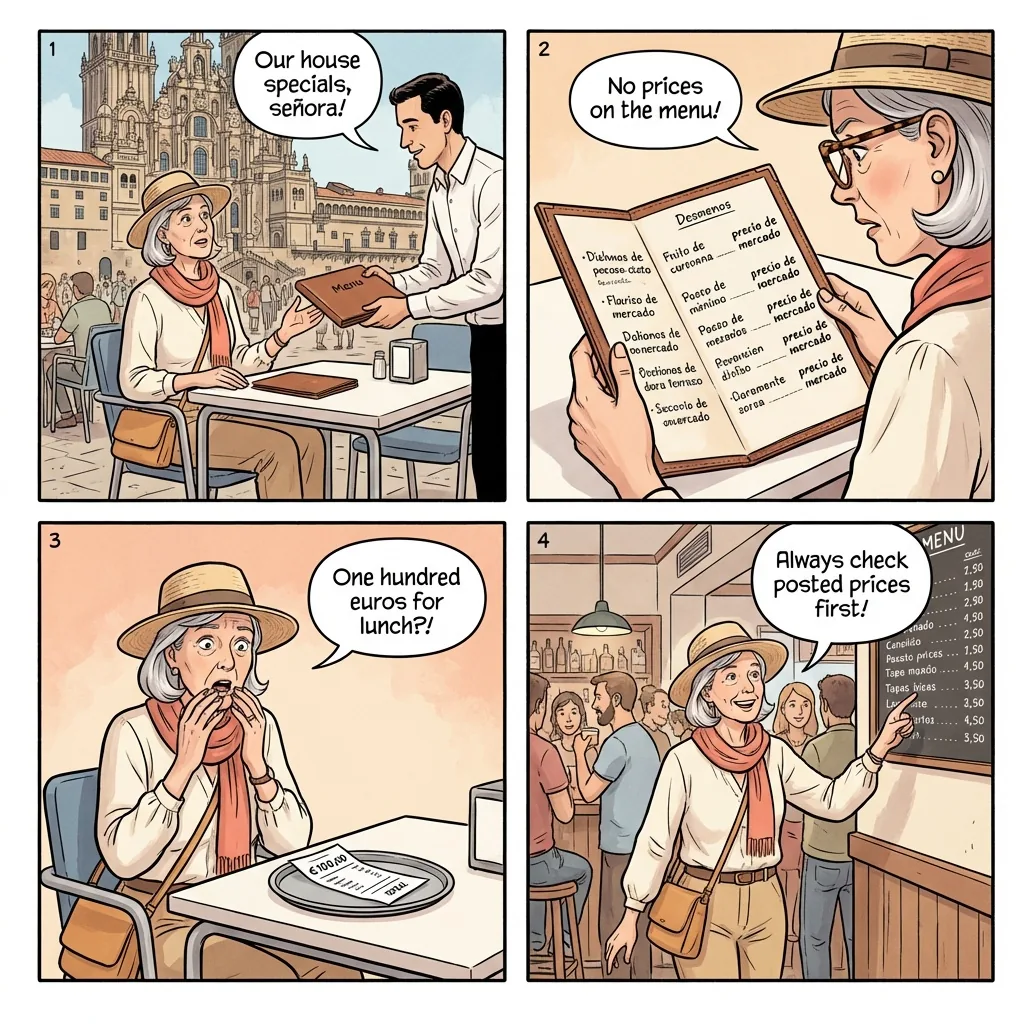
Rúa do Franco's 'menú peregrino' (pilgrim menu) restaurants steps from Santiago Cathedral charge €18–€25 for pre-frozen pulpo a la gallega, industrial empanada, and microwaved caldo gallego — a genuine Galician 'menú del día' at a residents' restaurant in the Ensanche 15 minutes away runs €10–€14 for the same three courses with wine, and the 'pilgrim menu' framing exists specifically to exploit credential-clad arrivals.
Rúa do Franco runs the closest restaurant strip to Santiago Cathedral and concentrates almost every newly-arrived pilgrim and short-stay visitor into the same dense block of 'menú peregrino' (pilgrim menu) restaurants advertising at €12–€25. Quality varies wildly across the strip — some places serve genuine Galician pulpo a la gallega, empanada gallega, and caldo gallego at fair prices, but the tourist-menu versions serve pre-frozen octopus, industrial empanada, and microwaved caldo at €18–€25 for a menu that should cost €10–€14 at a proper Galician restaurant. The 'pilgrim menu' framing exists specifically to exploit the credential-clad pilgrim demographic — travelers who've just walked 100 km and feel earned-rest energy reading 'pilgrim' as a discount signal rather than a markup signal.
The genuine Galician menú del día at a residents' restaurant in Santiago's Ensanche (new town, 15 minutes from the cathedral) or in the Pombal/San Lourenzo neighbourhoods runs €10–€14 for three courses plus wine — the same content as the Rúa do Franco €18–€25 'pilgrim menu' at half the price and substantially higher quality. Long-time Santiago community guidance is consistent that the 'pilgrim menu' on the cathedral strip is a tourist-trap layer, while the legitimate Galician food scene operates two neighbourhoods deeper. The same logic applies to specific Galician dishes — pulpo a la gallega should be from a wood-fired pulpería rather than a tourist-strip pre-frozen kitchen, empanada should be sliced from a fresh round at the market rather than reheated in a microwave, and caldo gallego should arrive hot from a pot rather than from a microwave-safe bowl. Cover-charge mechanics also apply: under Spanish law, unlisted cover charges can be fined, but tourist-strip restaurants on Rúa do Franco regularly add 'welcome olives,' 'cortesía bread,' or 'caldo cortesía' that turn out to be billed at €3–€6 per item.
For older travelers and pilgrims looking for a real Galician meal, the defense is to walk 15 minutes off the cathedral strip and order the menú del día at a residents' restaurant. Skip Rúa do Franco's 'menú peregrino' restaurants for sit-down meals — walk 15 minutes to the Ensanche (new town) or the Pombal/San Lourenzo neighbourhoods for a genuine Galician menú del día at €10–€14 (three courses plus wine) — at named honest spots like O Curro da Parra (traditional Galician), Bodeguilla de San Roque (tapas), Abastos 2.0 at the market (modern Galician), Casa Marcelo (Michelin Bib Gourmand open-kitchen tapas), or Pulpería A Parada (the community-respected pulpo specialist); confirm the outside menu matches the table menu before sitting, and refuse welcome olives, bread, or caldo 'cortesía' without confirming whether they're genuinely free under Spanish cover-charge disclosure law. All four restaurant recommendations have transparent posted menus and 4.4+ Google ratings with long review histories — the right anchor for older travelers who want a single high-quality Galician meal as the post-Camino reward rather than another microwaved 'pilgrim menu' on the cathedral strip.
Red Flags
- Restaurant on Rúa do Franco or Rúa do Vilar with no printed menu visible outside
- 'Menú peregrino' priced at €18–€25 (authentic local menu del día is €10–€14)
- Menu at the table differs from the one posted at the entrance
- Octopus, empanada, or caldo arrives cold or clearly microwaved
- Bill includes 'cubierto' (cover charge) or 'pan' (bread) not listed on the menu
How to Avoid
- Walk 15 minutes from the cathedral to Ensanche or Pombal/San Lourenzo for local prices.
- Community-respected posted-price Santiago: O Curro da Parra, Abastos 2.0, Casa Marcelo, Pulpería A Parada.
- Confirm outside menu matches table menu before sitting; walk out otherwise.
- For pulpo, choose a dedicated pulpería rather than a generic tourist restaurant.
- Authentic 'menú del día' is €10–€14; 'menú peregrino' above €18 is marked up for pilgrims.

Camino Francés luggage transfer has two legitimate operators — JacoTrans and Correos Paq Mochila at €5–€8 per day per bag picked up by 8 AM and delivered by 2 PM — but 'private pilgrim concierge' services pitch 'premium luggage transfer plus hotel upgrades' at €25–€40 per day, albergue owners offer 'friendly €20' transfers that become €30 'petrol surcharges,' and Facebook-group 'last-stage concierge' bundles at €200–€400 duplicate free Oficina del Peregrino services.
Pilgrims walking the last 100 km of the Camino Francés want to send their backpack ahead each day to the next albergue rather than carry the full load over a 25-kilometre stage. Two legitimate operators run this service across the entire Camino network with published rates and online booking: JacoTrans (jacotrans.com) and Correos Paq Mochila (elcaminoconcorreos.com), the Spanish postal service's Camino bag-transfer arm. Both charge €5–€8 per day per bag, pick up from any Camino albergue by 8 AM, and deliver to the destination albergue by 2 PM. Both have English-language websites and verifiable physical business addresses. Anything outside these two operators is either a markup or a scam.
The trap menu has three patterns. 'Private pilgrim concierge' services advertise 'premium luggage transfer plus hotel upgrades' at €25–€40 per day with vague delivery windows and no accountability if bags arrive late or get lost — three to five times the legitimate rate for the same service plus an upsell on hotels you don't need. 'Friendly transfer' offers from albergue owners pitch 'I'll drive your luggage myself for €20, faster than Correos.' The €20 typically becomes €30 'because of petrol' once the bag is in the car, and the bag occasionally arrives at the wrong albergue with the driver unreachable for the difference. Facebook pilgrim-group 'last-stage concierge' bundles at €200–€400 sell a packaged version of services the Oficina del Peregrino in Santiago provides free at +34 881 252 139 — Camino advice, credential review, distance-certificate processing, and emergency assistance. The Camino-veteran framework is consistent across all three: informal services along the route are nearly always markups on what official channels provide for less, and 'premium' framing is the marketing layer that converts free or €5–€8 services into €25–€400 line items.
For older pilgrims planning luggage transfer for the last 100 km, the defense is to use only the two legitimate operators with online booking. Use only JacoTrans (jacotrans.com) or Correos Paq Mochila (elcaminoconcorreos.com) for luggage transfer — both have English-language websites, published €5–€8 per day rates, online booking, and pickup from any Camino albergue by 8 AM with delivery by 2 PM — and refuse every 'private pilgrim concierge' service at €25–€40 per day, every albergue-owner 'friendly transfer €20' that turns into €30 'petrol' surcharges, and every Facebook-group 'last-stage concierge bundle' at €200–€400 that duplicates free Oficina del Peregrino services. Verifiable online booking and a physical business address are the two filters that separate the two legitimate operators from every markup variant. For Camino-related questions, contact the Oficina del Peregrino directly at +34 881 252 139 — paid versions of their free services are markups, not value-adds. If your bag is lost or delayed by JacoTrans or Correos, both have published claims processes; if it's lost by an informal 'friendly transfer' driver, you have no recourse.
Red Flags
- 'Private pilgrim concierge' offering luggage transfer at €25+ per day (JacoTrans/Correos is €5–€8)
- Albergue owner offers to drive your bag himself for cash, no written receipt
- Facebook group offers 'premium last-stage concierge' at €200–€400
- No verifiable online booking system or physical business address
- Service duplicates what Oficina del Peregrino offers free
How to Avoid
- Use JacoTrans (jacotrans.com) or Correos Paq Mochila (elcaminoconcorreos.com) — €5–€8 per bag per day.
- Both have English websites, published rates, and online booking.
- Refuse informal 'private' luggage transfer offers without a business address.
- For Camino-related advice, Oficina del Peregrino (+34 881 252 139) is free.
- Ignore Facebook-group 'concierge' packages that duplicate free official services.
🆘 What to Do If You Get Scammed
📋 File a Police Report
Go to the nearest Policía Nacional or Guardia Civil station. Call 091 (Policía Nacional) or 112 (emergency). Get an official crime report — you'll need this for insurance claims. You can also report online at policia.es.
💳 Cancel Your Cards
Call your bank immediately. Most have 24/7 numbers on the back of the card (keep a photo saved separately). Block any suspicious transactions before the thieves use your details.
🛂 Lost Passport?
Contact your nearest embassy or consulate. The US Embassy is at Calle de Serrano, 75, 28006 Madrid. For emergencies: +34 91 587-2200.
📱 Track Your Device
If your phone was stolen, use Find My (iPhone) or Find My Device (Android) from another device. Don't confront thieves yourself — share the location with police instead.
Frequently Asked Questions
You just read 6 scams in Santiago De Compostela. The book has 97 more across 16 Spanish destinations.
Barcelona's La Rambla rosemary-sprig clavel circuit. Madrid's Puerta del Sol three-card trile. Seville's Plaza de España palm-reading gambit. Granada's Alhambra skip-the-line reseller industry. Ibiza and Mallorca scooter deposit-hold cycle. Every documented Spain scam — with the exact scripts, red flags, and Spanish phrases that shut each one down. Drawn from El País, La Vanguardia, ABC, El Mundo, and Policía Nacional and Mossos d'Esquadra records.
- 103 documented scams across Barcelona, Madrid, Seville, Granada & 12 more cities and islands
- A Spanish exit-phrase card you can screenshot to your phone
- Updated annually — buy once, re-download future editions free
- Readable in one flight — $4.99 on Amazon Kindle